

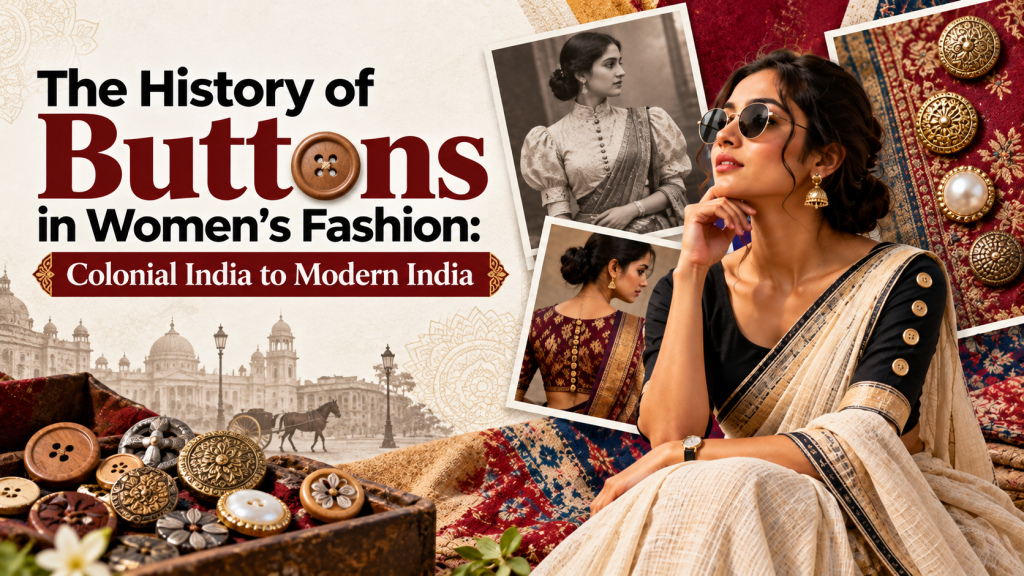
One clarification first: buttons themselves were not invented by the British or introduced to India for the first time during colonial rule. Button-like objects existed on the Indian subcontinent in antiquity and initially served more as ornaments than as the functional fasteners commonly used today.
What changed significantly during the colonial period was the wider adoption of European-style tailored garments and functional buttons in women’s clothing.
1. Prior to Colonial Influence: Clothing Was Largely Draped
For much of Indian history, clothing was made and worn by draping unstitched textiles rather than relying on Western-style tailored garments.
The sari, for example, could be arranged around the body without requiring a fitted, buttoned bodice. Historical writings also mention garments such as the antriya, uttariya, and stanapatta, although clothing practices varied across regions, communities, and historical periods.
Therefore, there was no single traditional Indian women’s outfit. Clothing styles differed according to regional customs, climate, social traditions, and the availability of materials.
2. Colonial India: Stitched Clothing Becomes More Influential
During the 19th century, greater exposure to British colonial society brought increased familiarity with European tailoring, dressmaking, and ideas about appropriate public dress.
The sari blouse gradually became an increasingly significant garment in women’s clothing across several parts of India.
The development of the modern blouse is particularly associated with Bengal and figures such as Jnanadanandini Devi, who helped popularise wearing the sari with a blouse and petticoat for public and social occasions.
This development had important implications for the use of buttons in women’s fashion because fitted blouses required fasteners such as buttons or hooks.
3. Buttons Become Part of the Blouse
Once fitted blouses became established, buttons began serving a practical function in addition to being decorative.
Historical blouse designs demonstrate a variety of features, including:
- Front buttons
- Back buttons
- Hooks and other fasteners
- High collars
- Different sleeve styles
- Fitted bodices
- Decorative trims
Some historical blouses, including Edwardian examples, used small mother-of-pearl buttons as part of their fastening systems.
In colonial India, Western-inspired blouse construction was adapted to Indian fabrics, embroidery, colours, and regional aesthetics.
As a result, buttons were no longer simply fastening devices. They also became part of a garment’s visual design, complementing its fabric, stitching, and embellishments.
4. Early 20th Century: Buttons Become Decorative Too
As women’s clothing became increasingly tailored, buttons began serving two important purposes: functionality and fashion.
Function: Making Garments Easier to Wear
Buttons helped open and close garments, making fitted clothing easier to wear and remove. They became useful features in blouses, shirts, jackets, and other tailored garments.
Fashion: Adding Style and Personality
Buttons also began adding visual interest, contrast, elegance, and personality to clothing.
This development was part of an international fashion movement. By the late 19th and early 20th centuries, buttons were being produced in increasingly diverse materials, shapes, and designs.
In Indian garments, buttons could be incorporated alongside materials and embellishments such as:
- Silk
- Cotton
- Embroidery
- Metal
- Glass
- Wood
- Shell
- Beads
These combinations allowed designers and craftspeople to coordinate buttons with traditional fabrics and decorative techniques.
5. Post-Independence India: Buttons Become Everyday Fashion
Since Indian independence in 1947, women’s fashion has continued to blend traditional clothing with modern tailoring.
Buttons have become common features in many types of garments, including:
- Blouses
- Kurtas
- Kurtis
- Jackets
- Dresses
- Cardigans
- Children’s clothing
- Shirts
The button was no longer associated specifically with Western clothing. It became an ordinary and versatile component of Indian fashion in its own right.
Designers began using buttons in different ways to complement traditional silhouettes, contemporary cuts, printed fabrics, and embroidered garments.
6. Modern India: From Fastening to Fashion Statement
Today, buttons can be both functional and decorative. A simple plastic button may be inexpensive, while designer garments can feature handcrafted, embroidered, metallic, wooden, ceramic, or embellished buttons.
In contemporary fashion, buttons can become the focal point of an entire garment. Their colour, shape, material, and placement can change the appearance of a blouse, kurta, jacket, or dress.
This concept is not limited to India. International designers have long used buttons as prominent decorative elements. For example, Chanel became famous for the distinctive buttons featured on its jackets and suits.
Contemporary designers continue to experiment with buttons as miniature design elements rather than treating them simply as garment hardware.
The growing variety of materials and designs demonstrates how buttons in Indian fashion can connect traditional craftsmanship with modern styling.
The Evolution of Buttons in One Line
Draped clothing → Stitched garments → Colonial-era tailored blouses → Functional buttons → Decorative buttons → Buttons as a fashion statement.
The Interesting Part: Did the British Introduce Buttons to India?
The history of buttons in Indian women’s fashion is not simply a story of the British introducing buttons to India.
Instead, it reflects how European-style tailoring and fastening systems became integrated into Indian women’s clothing, particularly during the colonial period, and were subsequently adapted into distinct Indian styles.
The blouse followed a similar trajectory. Influenced by changing ideas about clothing and public appearances, it gradually became so familiar that today it is often perceived as inseparable from the sari.
A tiny button, therefore, represents something much larger: the evolution from primarily draped clothing to increasingly tailored fashion and, eventually, the enormous diversity of modern Indian women’s clothing.
Conclusion
The journey of buttons reflects the changing relationship between clothing, culture, craftsmanship, and personal expression. From their use in tailored blouses to their role as decorative elements in contemporary garments, buttons have become an important part of the evolution of Indian women’s fashion.
Today, buttons are available in countless materials, shapes, colours, and designs, allowing designers to create garments that combine practicality with visual appeal. Understanding the history of buttons in Indian fashion helps us appreciate how a small clothing accessory can represent centuries of changing styles, cultural influences, and creative expression.