

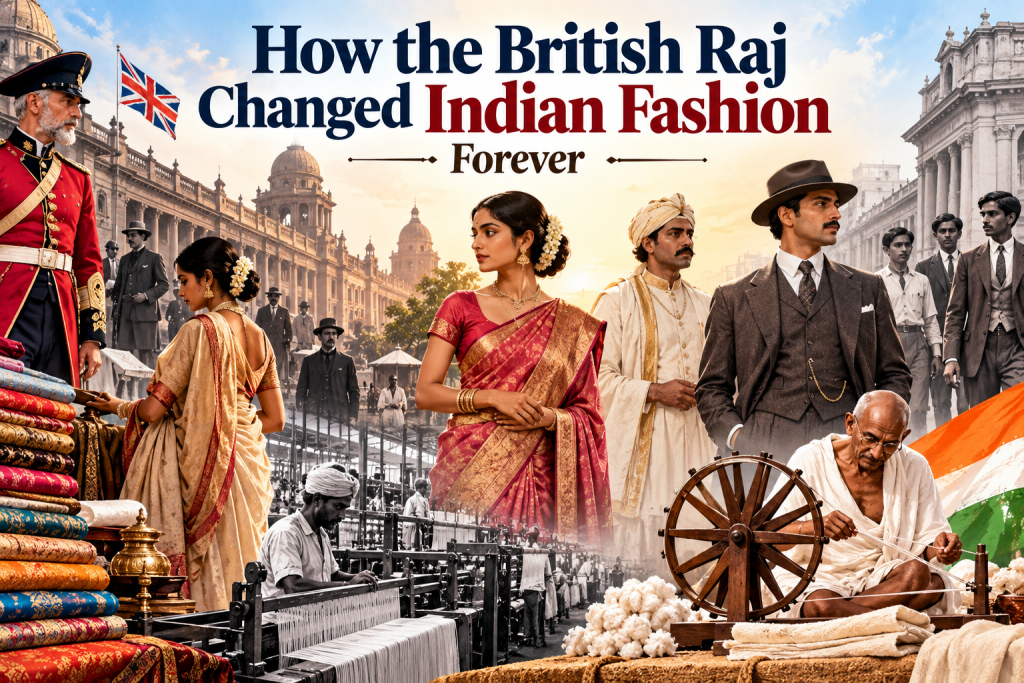
For centuries, Indian textiles were admired across the world. From fine cotton and delicate muslin to colourful silk and intricate embroidery, Indian fabrics were in high demand, even in Europe. British merchants were among those who traded in these textiles.
But as British rule over India expanded, the relationship between India and the textile trade began to change. Britain, which had once imported Indian fabrics, started sending large quantities of machine-made cloth to India. Gradually, British influence reached beyond the textile trade and affected the way Indians dressed, what they considered fashionable, and how clothing reflected social status.
The story of how the British Raj changed Indian fashion includes changes in sari styling, Western clothing, textile production, and the use of khadi during India’s independence movement. Some of these changes are still visible in Indian fashion today.
1. How the Sari Blouse Became Common
Think of a sari today, and you will probably picture it with a stitched blouse and a petticoat. For many women, this is the most familiar way to wear it. But the sari has been worn in different styles across India for centuries, and the blouse-and-petticoat combination was not always universal.
During British rule, European ideas about modesty and respectable dressing began to influence parts of Indian society. Women from certain communities, particularly in urban and educated circles, increasingly adopted stitched blouses and petticoats as part of their everyday clothing.
One woman often associated with this change is Jnanadanandini Devi, the wife of Satyendranath Tagore. In nineteenth-century Bengal, she helped popularise a style of draping the sari that was more convenient for women attending social gatherings and moving around in public.
Over time, the blouse and petticoat became common parts of sari dressing in many regions. However, this change did not happen everywhere at once. Local customs, caste, class, and regional traditions all played a role in how women dressed.
So, it would be wrong to say that the British invented the modern sari. The sari was already an established Indian garment. What changed was how many women began wearing it and what society expected them to wear underneath it.
2. Why Indian Men Started Wearing Western Clothes
Before British rule, Indian men wore a wide range of clothing, including dhotis, kurtas, angarkhas, achkans, and turbans. What someone wore often depended on their region, occupation, wealth, and community.
British rule introduced a different set of expectations, particularly in government offices, courts, and educational institutions. Shirts, trousers, jackets, and suits became increasingly associated with professional life and Western education.
For Indian men seeking government jobs or working in professions influenced by British institutions, Western clothing could be a practical choice. It could also help them fit into spaces where European dress was treated as the norm.
But Indians did not simply give up their traditional clothes. Many found ways to combine the two. A man might wear a Western coat with Indian clothing or choose a traditional garment for one occasion and a suit for another.
Clothing began to communicate more than personal taste. It could signal education, professional status, wealth, or a person’s connection to the changing urban world.
3. How British Factories Changed India’s Textile Industry
The biggest change was not just what people wore. It was also how their clothes were produced.
Indian cotton fabrics and muslin had long been popular in international markets. Indian weavers and artisans were known for their skill, and their products were sold far beyond the subcontinent.
The Industrial Revolution changed this situation. British factories could produce cotton yarn and cloth on a large scale using machinery. At the same time, trade policies and colonial economic arrangements increasingly favoured British manufactured goods in the Indian market.
Machine-made imports created serious competition for many Indian textile producers. Spinners, weavers, and artisans in different parts of the country faced economic pressure, although the effects varied depending on the region and the type of textile they produced.
India increasingly became a market for British-made cloth and an important supplier of raw cotton. This was a major shift for a country with such a long history of textile production.
The consequences reached ordinary households, too. The fabrics available in markets changed, and the cost and accessibility of different materials influenced what people could afford to wear.
In other words, British rule changed not only fashion trends but also the economic system behind the clothes Indians wore.
4. How Khadi Became a Symbol of Freedom
Western clothing was not the only influence of the colonial period. Clothing also became a way for Indians to push back against British rule.
During the independence movement, Mahatma Gandhi encouraged people to wear khadi, a hand-spun and handwoven fabric. He urged Indians to spin their own yarn and support local production rather than depend on British-made textiles.
The spinning wheel became a powerful symbol of self-reliance. Wearing khadi was no longer just a personal choice; it could be a statement of support for India’s freedom struggle.
The Swadeshi movement also encouraged Indians to buy locally made goods and reject foreign products, particularly British imports.
This gave everyday clothing a new meaning. A simple piece of fabric could represent national pride, economic independence, and resistance to colonial rule.
It is an interesting contrast: while British rule helped expand the market for Western clothing and machine-made textiles, it also inspired Indians to use their clothing choices to challenge that very system.
5. When Western Clothes Became a Sign of Being Modern
Fashion is rarely just about clothes. It is also about what society thinks those clothes represent.
During the colonial period, Western dress became associated in some circles with education, professional success, and modern life. People who wore European-style clothing could be seen as sophisticated or well educated, particularly in cities and among groups connected to British institutions.
Traditional Indian clothing, meanwhile, was sometimes unfairly viewed by colonial observers as old-fashioned or backward.
Not everyone accepted these ideas. Some Indians embraced Western clothing because it suited their work or lifestyle. Others mixed it with traditional garments, while many continued to wear regional clothing with pride.
The result was a complicated relationship between fashion and identity. What a person wore could influence how others perceived their education, social position, and cultural background.
Even today, the idea that Western clothing looks more professional in certain workplaces reflects a wider history of how dress codes and ideas about respectability developed.
6. Indian Fashion Adapted Rather Than Disappeared
Despite these changes, Indian fashion never simply became a copy of British fashion.
Instead, Indians adapted new styles to suit their own tastes, traditions, and needs. Western shirts and trousers became part of everyday wardrobes, while saris, kurtas, dhotis, and other traditional garments continued to be worn across the country.
Today, it is common to see Indian clothing paired with modern cuts, Western tailoring, and contemporary accessories. Designers combine traditional embroidery and weaving with newer silhouettes, creating styles that draw from both Indian and international influences.
It is also important to remember that Indian fashion had been evolving long before the British arrived. Trade, migration, royal courts, and cultural exchanges with Persian, Central Asian, and other communities had already influenced clothing across the subcontinent.
British rule was therefore one major chapter in a much longer history, not the beginning of Indian fashion itself.
Conclusion: British Rule Changed Indian Fashion, but Indians Shaped What Came Next
British colonial rule changed Indian fashion in several ways. It influenced how some women wore the sari, encouraged Western dress in professional settings, and transformed the textile industry through mechanised production and colonial trade.
But Indians were never just passive recipients of these changes. They adapted new styles, held on to regional traditions, and used clothing to express their identity. During the freedom struggle, garments such as khadi even became symbols of resistance.
The sari did not stop being Indian because the blouse became more common. Indian men did not abandon their heritage simply because they began wearing trousers and jackets. And khadi showed that clothing could be a statement of independence rather than an imitation of the West.
The British changed the way many Indians dressed, but they did not erase Indian fashion. Instead, their rule changed the social and economic forces shaping it, while Indians continued to decide what to wear, what to preserve, and what to make their own.