

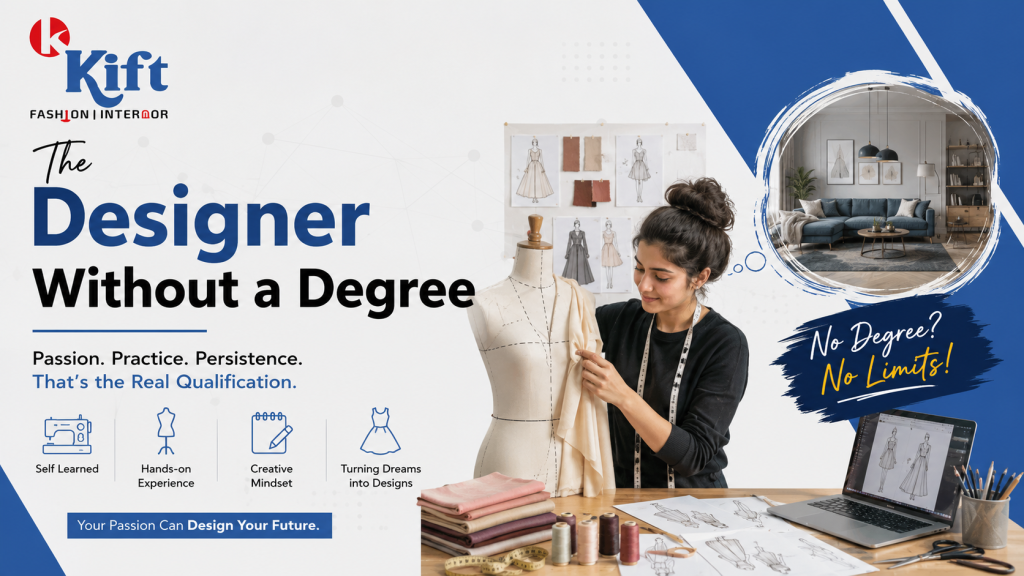
What started as casual conversations eventually taught me one of the most valuable lessons about the fashion industry.
An Unexpected Confession
One day, our conversation took an unexpected turn. She shared something that completely surprised me she didn’t have a formal degree in fashion designing. Everything she knew had been learned through self-study, practical experience, and an unwavering determination to improve.
That revelation led us into a deeper discussion about what it really means to become a fashion designer and whether formal education is the only path to success.
Learning by Doing, Not Just by Studying
She explained that her journey began long before she considered herself a designer. She worked in a garment-related job where she gained hands on experience with fabrics, stitching, measurements, and garment construction.
According to her, practical experience is one of the most valuable assets a fashion designer can have. Working directly with garments helped her understand things that books alone could never fully explain.
Teaching Herself the Fundamentals
While gaining practical experience, she simultaneously taught herself the technical aspects of fashion design. Through online tutorials, research articles, discussion forums, and constant experimentation, she learned:
- Garment construction
- Draping techniques
- Pattern making
- Basic sewing methods
- Fashion illustration
Once she became comfortable with these fundamentals, she expanded her skills by learning professional design software that could transform her ideas into digital designs.
Software She Learned
- Adobe Illustrator
- Adobe Photoshop
- Computer-Aided Design (CAD)
These tools enabled her to create professional sketches, visualize garments digitally, and communicate her ideas more effectively with clients.
Building a Portfolio Without Realizing It
Her learning journey didn’t stop with technical knowledge. She constantly practiced sketching new designs, purchased second-hand clothing to experiment with alterations, and re-stitched garments simply to improve her skills.
She photographed every project she completed, not because someone asked her to, but because she wanted to track her own improvement. Looking back, she realized she had unknowingly built a professional portfolio that showcased her growth as a designer.
She also invested time in understanding different fabrics, materials, textures, and their behavior. Learning how each fabric drapes, stretches, and responds to stitching became one of her greatest strengths knowledge that only comes from working directly with materials.
Skills Every Fashion Designer Should Develop
- Creative sketching and fashion illustration
- Garment construction and sewing
- Pattern making and draping
- Fabric and textile knowledge
- Adobe Illustrator and Photoshop
- Computer-Aided Design (CAD)
- Attention to detail
- Communication with clients
- Portfolio development
- Continuous learning and experimentation
Formal Education vs Practical Experience
| Formal Fashion Education | Self-Learning & Practical Experience |
|---|---|
| Structured curriculum | Learn at your own pace |
| Professional guidance | Real-world problem solving |
| Industry exposure through college | Hands-on experience with actual clients |
| Recognized qualification | Strong practical skills and adaptability |
| Networking opportunities | Experience gained through continuous practice |
The Real Lesson I Learned
Listening to her story changed the way I viewed fashion designing. I realized that while formal education provides valuable guidance and structured learning, true expertise comes from curiosity, consistent practice, patience, and the willingness to keep learning throughout your career.
A successful fashion designer isn’t defined solely by a degree but by the passion to create, the courage to experiment, and the discipline to improve every single day.
Her journey proved that persistence, self learning, and practical experience can build remarkable expertise. Whether someone chooses a fashion design course or learns through experience, the key to success remains the same: never stop learning, keep practicing, and let creativity guide the way.